BLACK TYGER STRATEGIES IS YOUR SECRET WEAPON
Without a strategic roadmap, the odds are stacked against your $25,000 investment before it ever gets spent. 56% of companies that invest in technology see zero return — no revenue increase, no cost reduction. Only 12% hit both goals. That means statistically, an unplanned $25,000 tech investment has roughly an 88% chance of underperforming or failing outright. That’s a potential $25,000 loss.
A $2,500–$5,000 roadmap and tech stack assessment represents just 10–20% of the total investment — but it’s the piece that determines whether the other 80–90% actually works. If that assessment moves you from the 88% failure bracket into the 12% success bracket, the ROI isn’t just good — it’s the difference between a $25,000 asset and a $25,000 mistake.
The simple math:
- Roadmap cost: $2,500–$5,000
- Protected investment: $25,000
- ROI if it prevents total loss: 400–900%
- ROI if it unlocks both revenue growth AND cost reduction: Compounding and ongoing
The roadmap doesn’t cost you money. Going without one does.
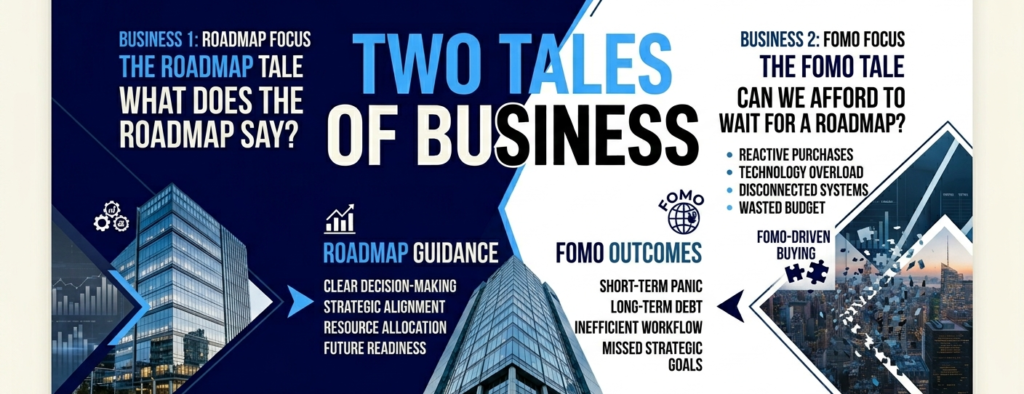
Actions without plans are fueled by panic, informed by fear and lead to disaster.
Marcus knew this…
Quincy didn’t…
The Right Question: What Does the Roadmap Say?
The Strategist
Marcus T. — COO, Spartan Logistics Company
ACT I
A competitor rolls out route-optimization software and cuts delivery times by 18%. Marcus’s board wants a tech response — fast. He raises his hand and says: “Before we buy anything, I need to know where we actually stand.” He brings in Black Tyger Strategies to run an IT Health Assessment and build a Strategic Roadmap — not just to hand him a report, but to stay in the room through every decision that follows.
ACT II
The assessment takes three weeks. What it reveals isn’t pretty: Spartan’s dispatch system runs on a 2014 database that can’t accept a direct API feed from any modern optimization engine. Two of the three vendors Marcus had shortlisted would have required a full middleware build — adding $15,000–$22,000 in unplanned dev costs to any purchase.
Because Black Tyger Strategies operates as a tech-agnostic consultancy, there was no preferred vendor to steer Marcus toward and no platform partnership to protect. The only agenda on the table was finding the right fit for Spartan’s actual stack, budget, and operational goals. The roadmap didn’t just flag the risks — it defined the integration requirements, identified the two domains scoring below 40 that needed remediation before any new platform would stick, and gave Marcus the criteria he needed to evaluate vendors honestly.
“We almost spent $30k to solve a problem we don’t actually have, using a tool that wouldn’t have worked on our stack.”
ACT III
Armed with the roadmap — and with the Black Tyger Strategies team embedded as the technical partner throughout the procurement process — Marcus issued a tight RFP to four vendors. He knew his constraints, his integration requirements, and exactly what questions to ask. The Black Tyger team evaluated each response against the stack reality uncovered in the assessment, not against vendor marketing.
One vendor stood out: a clean fit for the existing architecture, with a phased rollout path that addressed the two critical remediation domains without requiring a parallel infrastructure rebuild. Black Tyger Strategies supported the contract negotiation, ensuring the scope, timeline, and integration milestones were locked before a single dollar changed hands.
Total investment including the assessment and advisory support through selection: $31,000.
ACT IV
The platform is live across all locations. Black Tyger Strategies managed implementation oversight alongside Spartan’s internal team, catching a configuration issue in the dispatch integration before it hit production. Delivery times are down 21%. The roadmap also identified a secondary opportunity — driver scheduling inefficiency — that the new system addressed as part of the phased rollout.
Marcus’s CFO pulls him aside after the quarterly review: “That $3,500 assessment saved us at least $40,000 in avoided mistakes alone. Having the same team beside us through implementation meant we didn’t lose anything in translation. The returns on top of that are gravy.”
WHAT IS THE TOTAL INVESTMENT UNDER MARCUS?


TOTAL INVESTMENT UNDER MARCUS: $31,000
Delivery time: −21% · All locations live · Zero shelfware · Secondary efficiency gain captured
We see what a roadmap can do for Marcus and Spartan Logistics.
Lets’s see what the lack of one does for Quincy and Penguin Logistics.


The Wrong Question: Can You Afford a Roadmap?
The Reactor
Quincy M. — COO, Penguin Logistics Company
ACT I
The same competitive move hits Quincy’s inbox on a Friday. By Monday he’s on a demo call. By Wednesday he’s signed a $28,000 contract for a route-optimization platform, a fleet telematics add-on, and a real-time dispatch dashboard.
No assessment. No roadmap. His reasoning: “We can’t afford to fall behind.”
ACT II
Implementation begins. Three weeks in, the vendor’s onboarding team flags a problem: Quincy’s dispatch system can’t sync with the optimization engine’s API without a custom connector. The vendor quotes $18,000 to build it.
Quincy approves — what choice does he have? He’s already in.
I thought we were buying a solution. Turns out we were buying the right to spend more money on the actual solution.”
ACT III
The connector gets built. Eight weeks behind schedule, the platform goes live — partially. The fleet telematics system requires a hardware install the vendor’s proposal never mentioned. Three of Diane’s 11 depots are too old to support it.
The real-time dashboard is pulling data from the legacy system, which updates every 47 minutes. “Real-time” is a generous term.
ACT IV
Total spend: $28,000 platform + $18,000 connector + $9,000 partial hardware + $6,500 in internal IT hours debugging sync errors = $61,500.
Delivery time improvement: 6%. Three depots still aren’t on the system. The fleet telematics module is shelfware at two locations.
The CFO schedules a post-mortem. The word “waste” appears four times in the first slide.
WHAT IS THE TOTAL INVESTMENT UNDER QUINCY?
TOTAL INVESTMENT UNDER QUINCY: $61,500
Delivery time: −6% · 3 of 11 depots offline · Two shelfware modules · Post-mortem scheduled

The 90-Day Roadmap vs. 3-Year Strategic Vision — You Need Both
One of the most consistent findings in business technology research is that companies failing to see returns from their investments share a common thread — they never had a real roadmap. Not a slide deck. Not a wish list. A roadmap. A 90-day plan gives your team immediate traction, creates momentum, surfaces quick wins, and builds the internal confidence that meaningful change is actually possible. But a 90-day plan with no long-term vision is just organized activity. You’ll be busy, but you won’t be building anything that compounds, and busy without direction is one of the most expensive places a business can live.
Real transformation takes time. Not because the work is slow, but because the work that matters — the kind that reshapes how your business operates, competes, and grows — has to be done in the right sequence, with the right foundation underneath it. There are no shortcuts to building something that lasts, and any partner who tells you otherwise is selling you speed at the expense of substance. At Black Tyger Strategies, we are not interested in a quick engagement that looks good on a case study. We are interested in what your business looks like three years from now, and we are willing to do the patient, deliberate work it takes to get you there.
That is why every client partnership we enter begins with two things working in parallel — a 90-day roadmap that tells us what to do next Monday, and a 3-year strategic vision that tells us why it matters and what it is building toward. The short-term plan creates momentum. The long-term vision creates meaning. Without both, you are either moving fast with no destination or dreaming big with no traction. With both, every initiative has a timeline, an owner, a measurable outcome, and a reason that connects directly back to where your business is going.
With 95% of AI pilots at major companies failing to generate meaningful revenue acceleration, the evidence is clear that throwing tools at a problem without a cohesive strategy is a guaranteed way to burn budget and build frustration. The companies winning with technology right now are not the ones who spent the most — they are the ones who planned the best and had a partner committed enough to see the plan through. We don’t come in, deliver a report, and move on to the next client. We stay. We measure. We adjust. And we hold ourselves accountable to the same outcomes we helped you define, because a transformation that isn’t finished isn’t a transformation — it’s an expensive start.
If you are looking for a quick fix, we are probably not the right fit. If you are looking for a partner who will still be beside you when the work actually starts to compound — let’s talk.
CONTACT US
Your digital presence & technology are either opening doors for your business or quietly closing them — and most organizations don’t find out which until an opportunity or competitor has already passed them by.
Black Tyger Strategies is not a web agency. We are a Full Stack Digital Solutions Consultancy, and the difference matters. Where a typical agency builds you something that looks good, we build you something that works — aligned to your business strategy, integrated with your operations, and designed to deliver measurable outcomes from the moment it goes live. Every digital decision we make is filtered through one question: does this move your business forward?
Your digital presence & technology should be some of your hardest working business assets. If they aren’t, that’s exactly the conversation we should be having. Let’s talk.